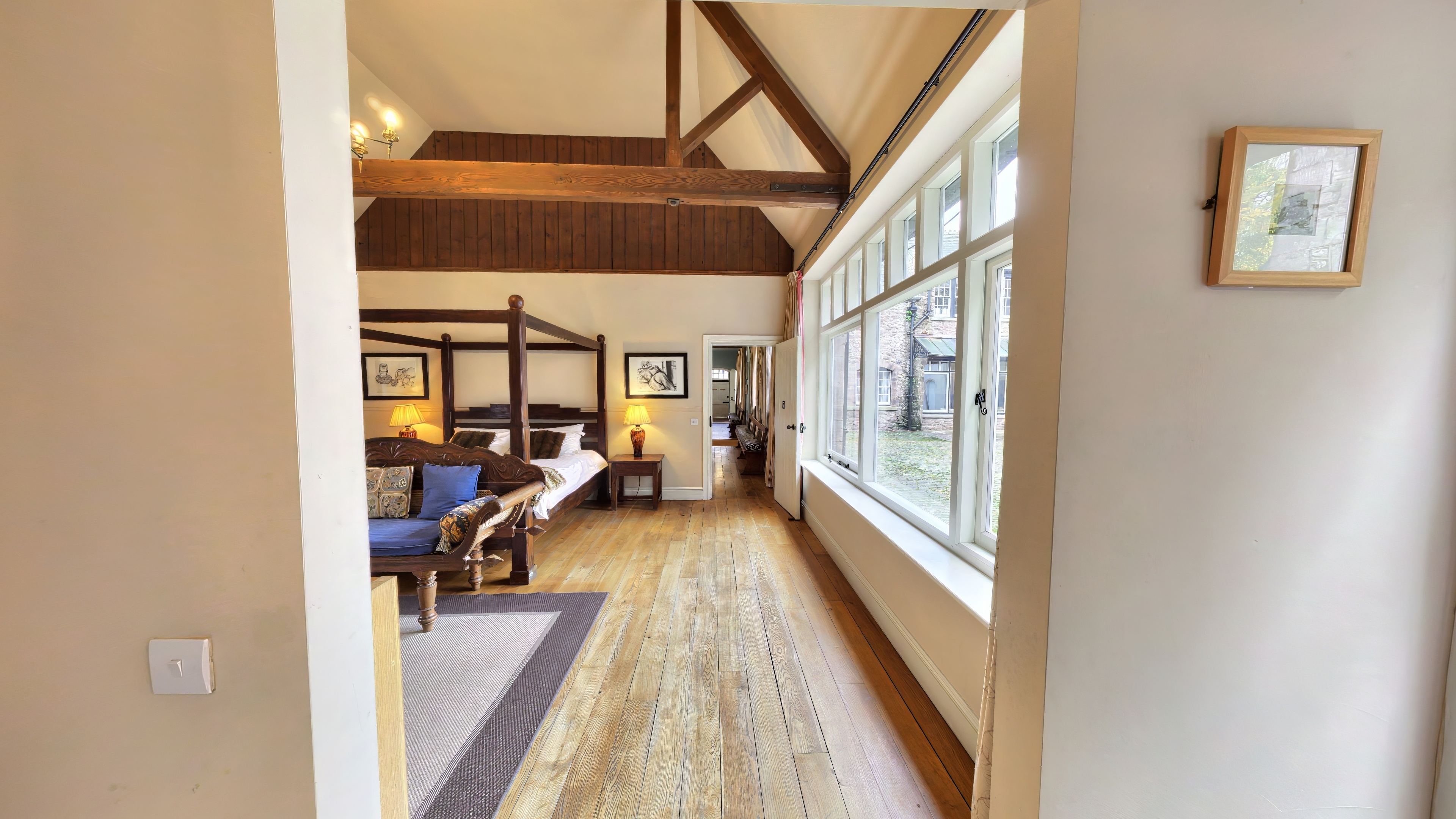
A prospective guest emails: "Could you explain where The Forge sits in relation to the main house?" The coordinator answers it. The same question arrives the following week. And the week after. It is not a failure of hospitality — it is a gap in information. A virtual tour is, among other things, the permanent answer to questions that do not need a human to answer them every single time they are asked.
The commercial conversation around virtual tours tends to focus on marketing: more enquiries, better engagement, higher online conversion. Those benefits are real. But for venues managing a high volume of pre-booking contact, the more immediate return on investment is operational — and it compounds quietly, one answered email at a time. This comprehensive guide works through the virtual tour ROI question from both sides: the hard numbers, a real UK case study, and the practical steps that maximise the return once your tour is live.
Quick takeaways
- WeddingDates (UK, 2023): venues convert approximately 1 in 3 show-rounds — meaning 2 in 3 represent sunk staff time with no revenue return
- White Heron Estate, Herefordshire: a bespoke See3D tour with interactive floorplan navigation led to a significant reduction in pre-booking layout enquiries
- Gaussian splatting extends the tour to exterior grounds — allowing guests to navigate the whole estate in 3D before ever making contact
What is the ROI of a virtual tour? Start with how people decide
A 360 virtual tour is interactive content, and that distinction drives the economics. A photograph or brochure is glanced at; a tour is explored. Industry data across property, hospitality and retail points the same way: visitors spend longer on pages with an interactive virtual tour, and the longer someone chooses to experience a space digitally, the more qualified their enquiry when it arrives. Adoption accelerated during the COVID-19 pandemic, when in-person viewing wasn't possible — and the behaviour stuck, because for potential customers a tour removes the risk of wasting a trip.
The use of virtual tours pays back through three channels: more enquiries (lead generation from a wider audience), better enquiries (pre-qualified prospective clients who have already explored the space), and fewer hours spent answering spatial questions or hosting site visits that were never going to convert. The first two are marketing returns. The third is an operations return, and it is the one this case study quantifies.
Which industries benefit most from offering virtual tours?
Real estate is the most-measured market: agents use tours to pre-qualify potential buyers, and landlords to shorten the void between lease viewings. Hospitality follows close behind — hotels, wedding venues and event spaces sell an experience, and a tour is the closest a guest gets to it before booking. High-end retail and showrooms use a virtual showroom as a permanent product detail page for the space itself, a pattern borrowed from e-commerce. And venues with complex, multi-building layouts — the subject of the case study below — see the strongest operational returns of all, because they field the most spatial questions per booking.
Virtual tour vs video: which earns its keep?
A walkthrough video is passive — fixed path, fixed pace, watched once. A 3D virtual tour hands control to the viewer: they choose where to go, linger on what matters to them, and click a hotspot when they want detail. That control is why interactive virtual experiences out-engage video for spatial decisions, while video remains better for atmosphere and storytelling. The honest answer for most venues is both, with the tour doing the conversion work: video as the advert, the tour as the viewing. (Platforms differ too — Matterport 3D tours carry a recurring subscription, while See3D's virtual tour services are hosted permanently with no platform fee, which changes the payback arithmetic from year one.)
What a show-round actually costs
According to WeddingDates' 2023 UK industry report — which surveyed over 1,300 newly engaged couples — venues convert approximately one in three show-rounds into a confirmed booking. For a venue completing 30 show-rounds to secure 10 bookings in a year, 20 of those visits produce no revenue.
The cost of a failed show-round is not zero. A UK events coordinator earns approximately £25,500 per year (Reed.co.uk, 2024–25 data), working out at roughly £13 per hour. A show-round takes at minimum an hour to conduct. Add preparation — dressing the space, briefing the team, following up after the visit — and a single failed show-round realistically represents two hours of coordinator time, or approximately £26 in direct staff cost.
For a venue running 30 show-rounds per year at a 1-in-3 conversion rate, that is roughly £520 annually in coordinator time spent on visits that do not convert. Before any consideration of the time spent preparing refreshments, arranging access, or disrupting existing guests already staying on site.
Then there are the smaller, quieter costs: the layout enquiries. The "how many en-suite rooms does the cottage have" emails. The "where exactly is the mezzanine bedroom" calls. The "does the terrace connect directly to the dining room" messages. Each takes ten minutes. Over a year, they become hundreds of hours. WeddingDates 2024 data shows that 68% of couples visit three or fewer venues before booking — the shortlisting already happens digitally. A virtual tour ensures your venue makes that shortlist without requiring staff contact to do so.
The enquiry that photography cannot answer
Photography does one job well: it shows a room at its best. It cannot show how rooms connect. It cannot communicate which direction windows face, how a mezzanine relates to the floor below, or how far one building is from another on the estate. For a simple city restaurant or a standard hotel suite, photography is sufficient to set expectations and drive bookings.
For multi-building estates, country houses with unusual room configurations, and venues where the spatial experience is central to the booking decision, photography leaves a gap. Guests are not asking basic questions because they lack imagination — they are asking because the information they need to commit to an enquiry simply is not available in the format a photograph provides.
A virtual tour with interactive floorplan navigation closes that gap permanently.
White Heron Estate: a case study in spatial complexity
White Heron Estate in Lyonshall, Herefordshire, is a luxury rural estate comprising multiple distinct buildings: The Colloquy — a substantial two-floor property with an internal courtyard, a galleried bedroom over the sitting room, and spaces named The Buttery, The Scullery, and The Ingress — alongside The Forge, with its superking suite and mezzanine bedroom above, Gardeners Cottage, and associated outbuildings. The estate accommodates large groups across the full site.
The challenge was not the photography. The estate photographs beautifully. The challenge was spatial comprehension: prospective guests booking for a large group needed to understand which building was which, how they related to each other across the grounds, and what a mezzanine level or a galleried room actually looked and felt like to stay in. Photography could show each room. It could not show the estate as a coherent, navigable system.
See3D built a bespoke virtual tour for the estate with interactive floorplans for each building. Blue hotspot markers, mapped to the precise scan positions on the plan, allow a visitor to click any room on the floorplan and move directly to that viewpoint within the tour — standing in The Buttery, looking toward the courtyard, understanding immediately where they are and how it connects to the bedroom above.
White Heron Estate
Interactive floorplans — embedded within the See3D tour
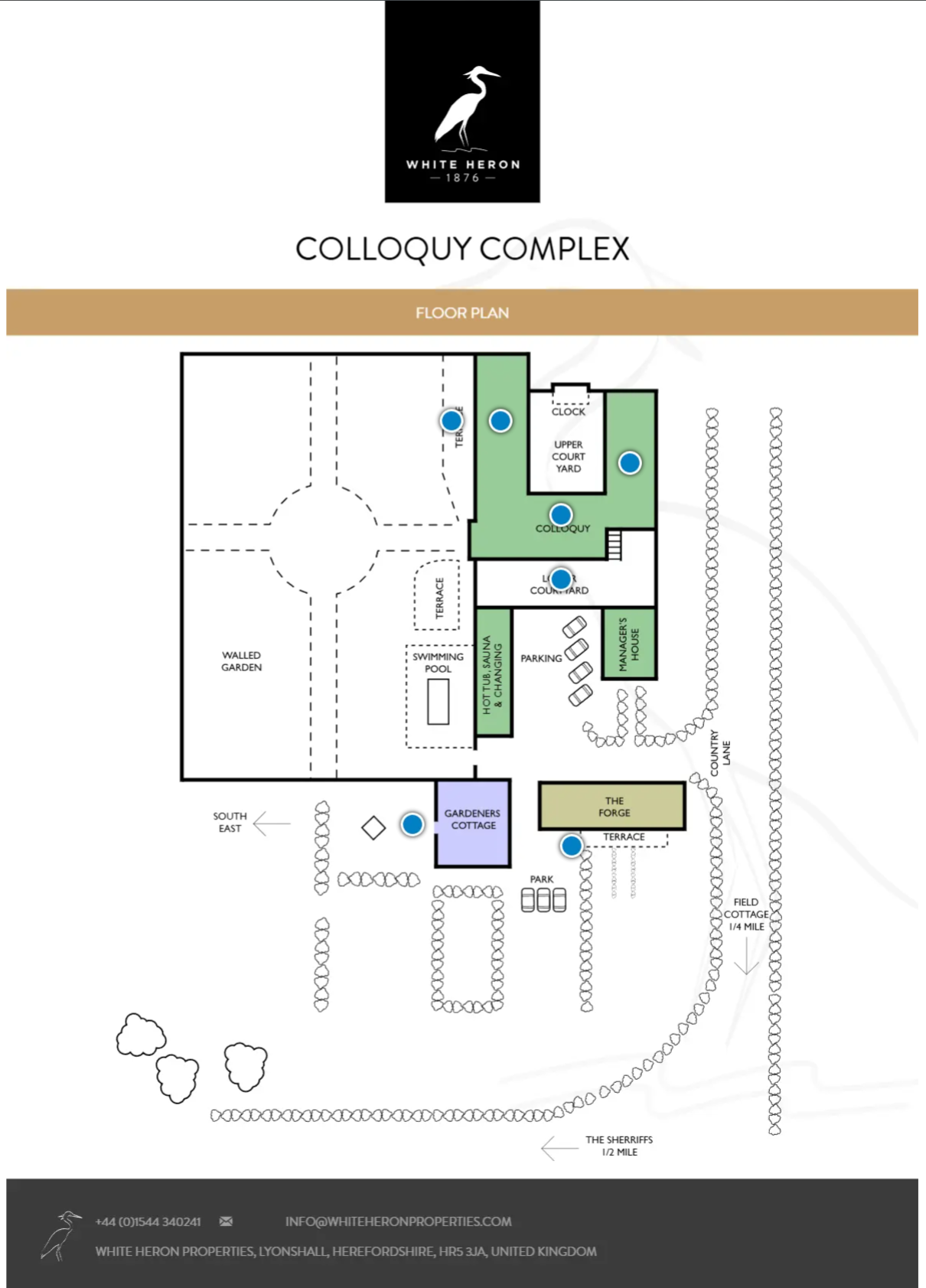
Colloquy Complex — site overview showing all buildings and grounds
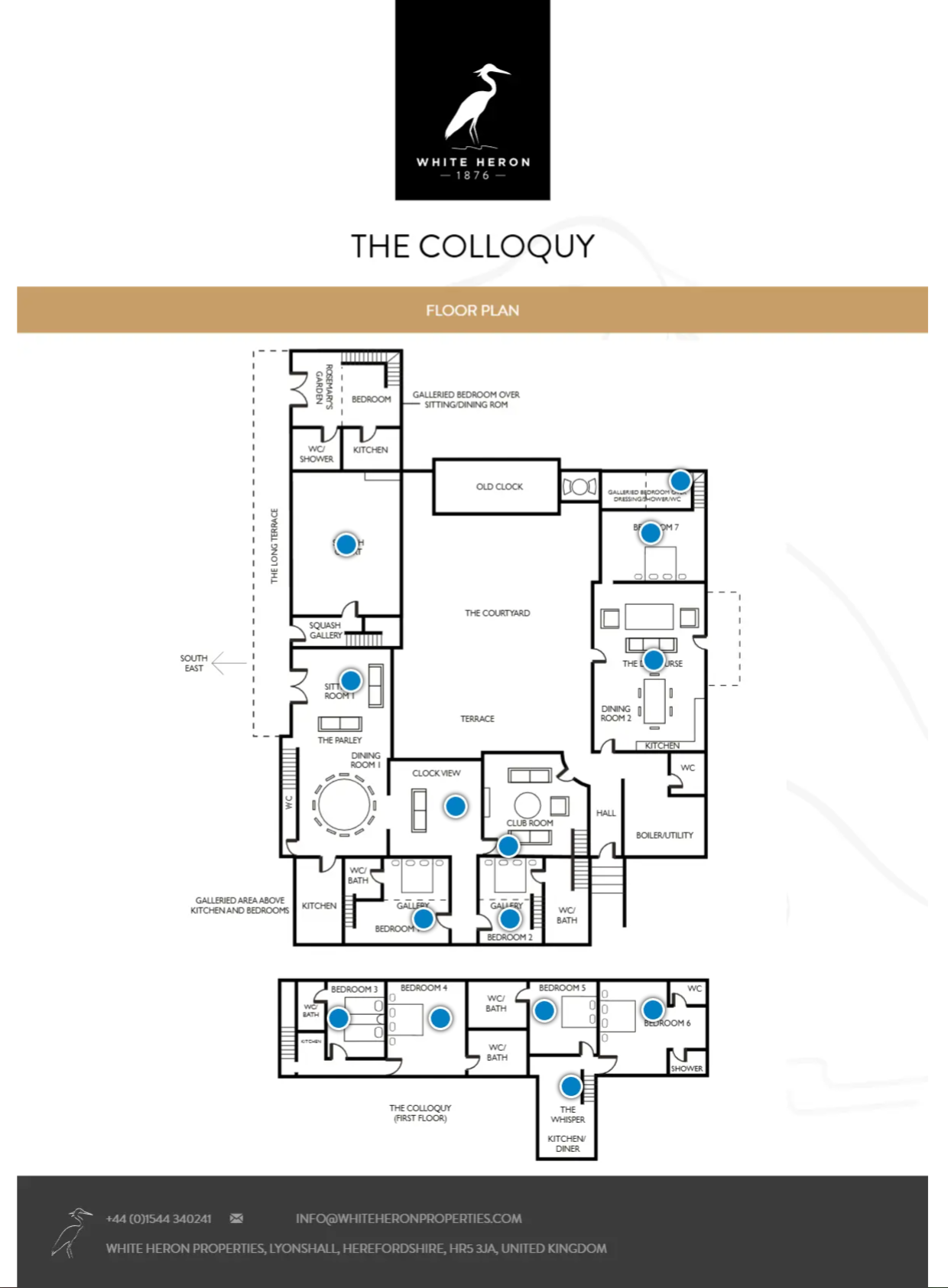
The Colloquy — two floors, galleried bedroom, internal courtyard

The Forge — superking suite with mezzanine bedroom
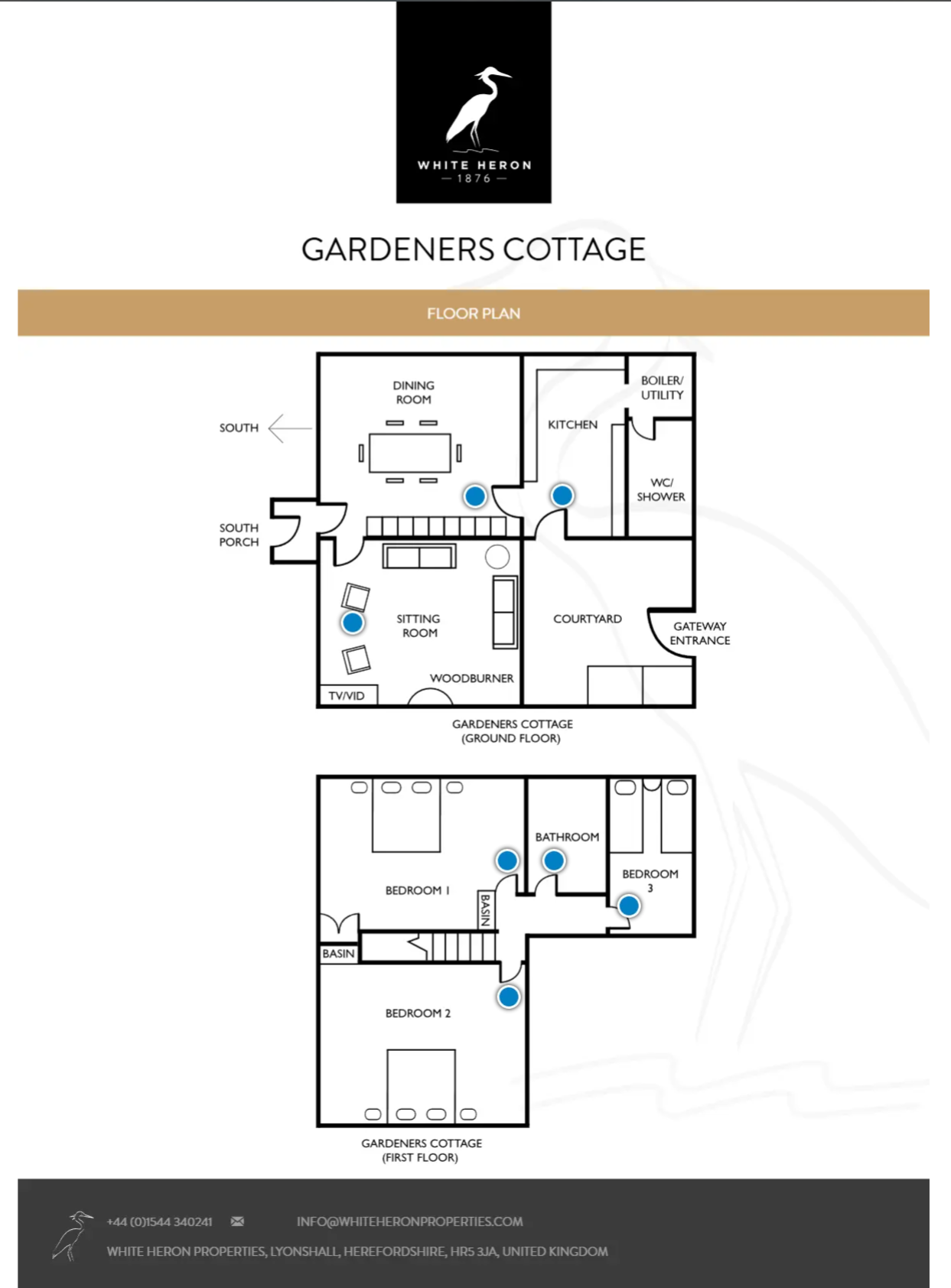
Gardeners Cottage — ground and first floor
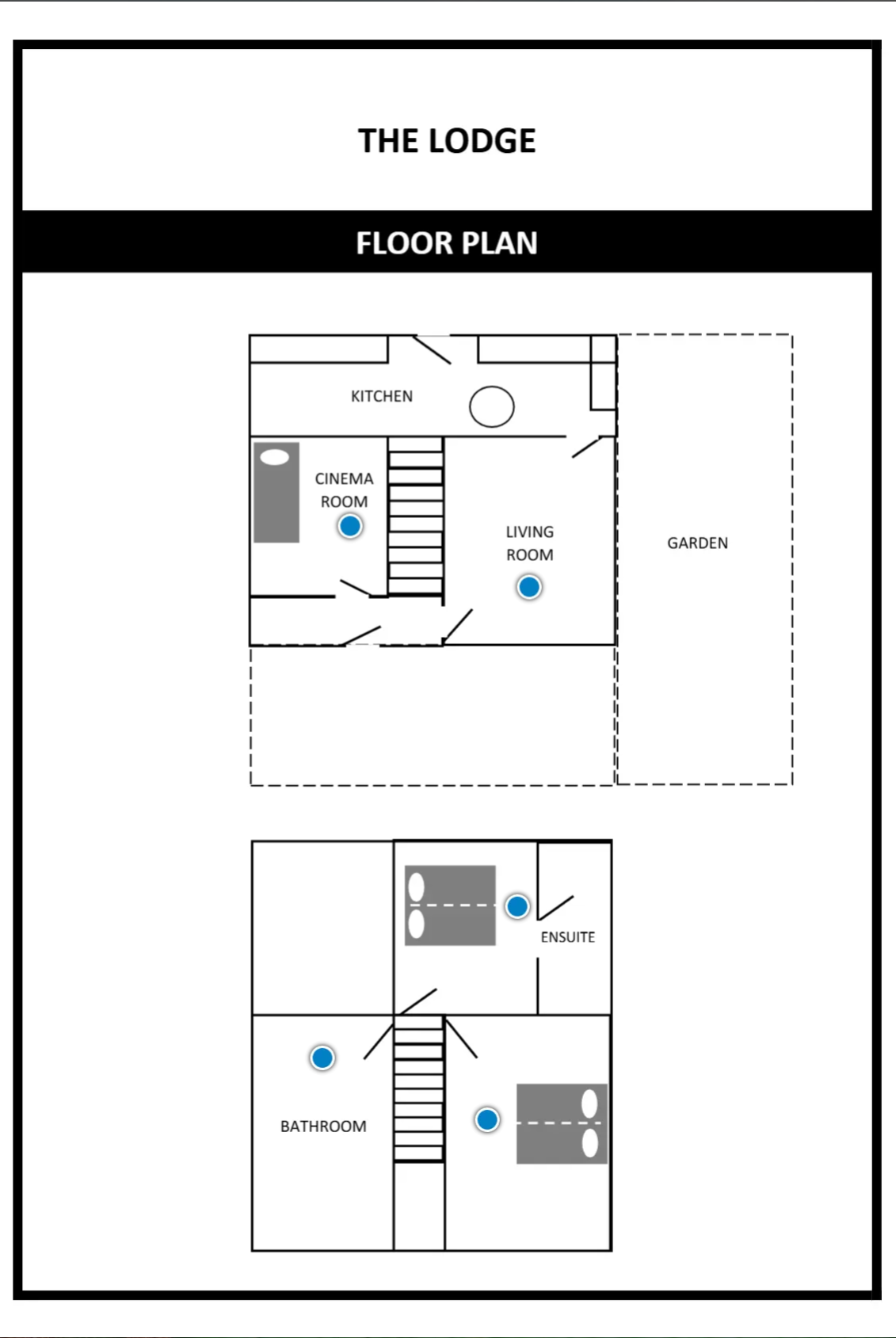
The Lodge — cinema room, living room, en-suite
Each blue hotspot marker on the plan corresponds to a precise scan position within the tour. Clicking any room navigates directly to that viewpoint — no browsing required.
Floorplan navigation — in action
Clicking a room on the floorplan moves directly to that scan position within the tour
The tour is live at tours.see3d.ai/WhiteHeron.
The White Heron team report a significant reduction in pre-booking enquiries following the tour's introduction.
Gaussian splatting: the question that even a floorplan cannot answer
Even a floorplan-navigated interior tour leaves one dimension unaddressed: the external grounds, and how the buildings sit within them as experienced from the outside. A site plan communicates this in two dimensions. Drone photography shows it from above. A walkthrough video records one fixed path. None of these place a prospective guest at ground level in the walled garden, able to turn around and understand where the pool is, where the cottage entrance is, and how far it is to walk to the main house.
Gaussian splatting changes that.
A Gaussian splat is built from overlapping photographs of a real environment. The result is not a point cloud and not a video — it is a photorealistic, fully three-dimensional model that runs in a web browser without specialist software. A visitor navigates it as they would a real space: moving through it continuously, from any viewpoint, pausing to look in any direction.
For an estate like White Heron, a Gaussian splat of the external grounds allows a prospective guest to explore the entire property: walk the paths between buildings, understand how the walled garden relates to the cottage, see the estate at human scale from ground level. Hotspot markers embedded in the model link directly to interior spaces — stand outside The Forge, click the entrance, and step inside to the full 360° interior tour.
This is the hybrid model See3D has developed for White Heron: Gaussian splat exterior combined with floorplan-navigated interior tours, creating one continuous digital experience that follows the guest's natural journey. Arrive at the estate. Orient in the grounds. Choose a building. Step inside. Every spatial question answered before it is ever asked.
Building the payback model
The scan is a one-time cost. Every enquiry the tour prevents is a compounding return.
A simple model: if a venue coordinator currently handles fifteen layout enquiries per week — room configuration questions, building relationship questions, "what does the mezzanine look like" calls — and each takes ten minutes to research and answer, that is 2.5 hours per week in staff time. At £13 per hour, that is approximately £33 per week, or around £1,700 per year, redirected to questions a virtual tour answers permanently.
On the show-round side: if a virtual tour pre-qualifies prospective guests so that those who do request a show-round have already explored the estate digitally — and as a result the failed show-round rate reduces by even five visits per year — the direct staff cost saving is approximately £130. At ten fewer failed show-rounds annually, it is £260. These are deliberately conservative figures; the reality for an active venue with complex accommodation will be higher.
The virtual tour does not pay for itself instantly. Over two or three years, for a venue fielding consistent spatial enquiries, it typically more than recovers its cost in coordinator time alone — before the marketing benefits are counted. The question is not whether it is worth the cost. The question is how many months it takes to break even. For most venues, the answer is measurable in months.
How to maximise virtual tour ROI: put the tour where decisions happen
A tour reaches its full potential only if people find it. The venues that get the most from offering virtual tours treat the tour as a distribution asset, not a page decoration:
- Embed the virtual tour on your website — on the landing page guests actually arrive at, next to a clear call to action, not buried three clicks deep. The tour is your strongest selling point; place it where it can convert leads.
- Publish to Google Street View — connecting the tour to your Google Business Profile means it appears in Google Search and Maps results, where local search decisions are made.
- Leverage social media and email — a tour link in a newsletter or a Meta ad campaign gives targeted advertising something genuinely different to show; influencer marketing partners can walk their audience through the space rather than past it.
- Help search engines understand it — descriptive page titles, metadata and schema around the embedded tour support your wider SEO and digital marketing efforts.
- Use it in sales conversations — coordinators can answer a spatial question by sending the exact viewpoint, which streamlines enquiry handling and impresses new clients.
- Extend it to virtual reality — the same tour runs in VR technology headsets for wedding fairs and trade shows, an immersive experience that a screen cannot quite match.
Tracking ROI: analytics and engagement data
Return on investment only becomes a number when you measure it. Analyse the engagement data your tour and website analytics already produce: how many people open the tour, how long they spend in it, which rooms they linger in, and the click-through rate from tour to enquiry form. Pair that with what your team observes — fewer repetitive layout questions, better-prepared show-round guests — and compare against the one-time scan cost. For most venues this is a powerful tool precisely because the inputs are simple: coordinator hours saved, bookings per viewing, and a tour that keeps working without a subscription. That 3D visualization of your space, captured once, is the rare marketing tool whose cost ends while its returns continue.
Sources & references
- WeddingDates, 2023 UK Industry Report. Survey of over 1,300 newly engaged couples. "Venues convert approximately one in three show-rounds into a confirmed booking." getwedpro.com
- Reed.co.uk, 2024–25 salary data. "A UK events coordinator earns approximately £25,500 per year." reed.co.uk